I think this is my favourite new dish for Winter, though I had never even heard of it before January. I’m pretty eager to try “new” Persian dishes.
Continue reading “Persian Noodle and Legume Soup (Ash-e Reshteh)”
Just another blog.spi.ryerson.ca site
I think this is my favourite new dish for Winter, though I had never even heard of it before January. I’m pretty eager to try “new” Persian dishes.
Continue reading “Persian Noodle and Legume Soup (Ash-e Reshteh)”
I love when basil is in season. Instead of the puny grocery store offerings, I get to come home with something I would describe more like a ‘bouquet’ of basil. As I walk home from the market, the basil wafts out of my canvas bag and I try to decide what exactly to do with all of this basil. Unless I’m feeling adventurous, there is really only one answer that will suffice. PESTO.
Continue reading “Basic Basil Pesto”
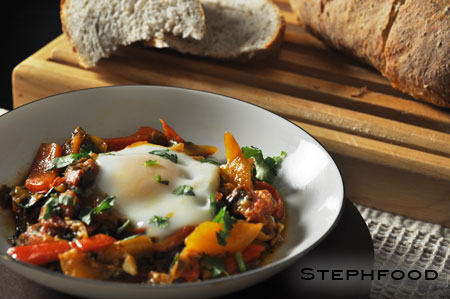
Shakshuka is a North African dish that is mostly eggs cooked in tomato sauce – with other things added to it to make it interesting – eaten with bread. In this case, we added colourful bell peppers, onions, and herbs. Incredibly simple – but so very good.

“Grillin’ and salad” season is in full swing. Over the next couple of months, there will be more days like today, where it’s just too hot to consider standing over the stove.

There weren’t many dishes I ate that contained bulgur. Until recently, the only thing I could think to make was tabbouleh. Fair enough – tabbouleh is tasty!
Eating my way through Turkey, I realized that you could get bulgur in different sizes, in many stages between fine and coarse. The coarser bulgur was used much like rice, and bulgur pilaf was a common side for many dishes.
I bought a bag of coarse bulgur, ready to make some delicious pilaf… and it sat in the cupboard for almost a month. J finally dug in, and used some in a bread, and I decided I couldn’t let him show me up.
The basic bulgur pilaf is fairly plain, since it’s meant to be a side dish for more flavourful main items, like kebab and kofte. I used the recipe from the cookbook I bought in Turkey as a jumping off point, adding some spinach and lots of yummy herbs and spices. I also had to change the cooking instructions a little bit — this will vary depending on the coarseness of the bulgur you buy. There are many variations, and I’m not sure there’s a standard way that all brands differentiate between the varieties.
This is a great alternative to a rice side dish – it has a nice chewiness to it, and is fantastically tangy from the mix of tomato, fresh mint and sumac.
It’s also amazing as leftovers.

Qormeh Sabzi (also written as Ghormeh Sabzi) is thought to possibly be the national dish of Iran, and after just one bite I could understand why.
Although made up mostly of an assortment of fresh herbs, there is no doubt that the real stars of the show are the Persian dried limes, leemoo-amonee (or “Limu-omani”). They aren’t exciting to look at, in fact you might find them kind of ugly (J thought they looked dusty), but they add the most amazing flavour to the dish that I’m sure can’t be replicated. I was lucky enough to find some at Akram’s, in Kensington Market.
Kensington Market is also a great place to find lots of fresh herbs at a decent price. I bought almost all of the herbs I needed there.

How to describe Qormeh Sabzi? It’s a rich, dark green stew made up of lots of herbs, kidney beans, lamb and the leemoo-amonee. It’s kind of hard to describe how the herbs taste in it, because it’s very different from using fresh herbs to a dish – it’s more like when you cook with leafy greens, like spinach. The dried lime doesn’t make the stew incredibly sour – because they are whole, and dried, a mellow lime flavour comes out. That is, unless you press the liquids out of the lime after cooking – this will intensify the lime flavour, and is sometimes best done in your own dish, if you are serving a group.
If you want to live on the edge, you can even eat the lime. I like to eat the outer parts – they are very strong, and a little bitter, but so much fun!
The lamb is actually a pretty important part, and this time around I opted to go without it. I haven’t cooked meat in about 15 years, and this is the first dish that has made me want to change that. Anyone that has had lamb knows that it has a strong flavour – this is why I like it, and why others don’t. That’s why, for me, it really is important in Qormeh Sabzi. My version of the dish was missing that aspect of the flavour. Other people make it with beef instead, which would make it taste a little bit different (good for folks who don’t like lamb).

Not the prettiest picture, but soooo delicious.
If you haven’t had Persian food before, you are missing out!! So was I, until earlier this year. If you like complex flavours, stews, interesting ingredients, you should definitely try this. People who like Indian food will probably like this — sure, there are lots of differences (for one, Persian food is not nearly as spicy hot!), but there are some similarities as well (basmati rice, stews, legumes).
People in Toronto should try Pomegranate restaurant, on College St. near Bathurst. It’s usually busy, so be sure to make reservations!! You won’t regret it!

This is the first installment of my ‘Cookbook Diving’ series, where I dig up recipes from my lonely little cookbooks. I have a number of cookbooks that I rarely use, especially now that it’s so easy to find recipes on the internet. I thought it was about time I start finding some tasty treasures on my own bookshelf, so here we go!
Earlier, I posted about our Greek themed meal featuring my first attempt at Spanakopita. Since we couldn’t make an entire meal out of spinach pie, I thought I should dig around for some other treats. I decided to make eggplant bundles, stuffed with tomato, herbs and cheese. This recipe is actually from an Italian cookbook, but since many of the ingredients cross over with Greek cuisine, I thought I could modify it to make it work with our meal. I did the obvious, and simply replaced the herbs and the type of cheese used, since they wouldn’t change the basic structure of the dish.

These were very simple to make, but some of them didn’t want to stay together when I flipped them on the baking sheet. No worries! It’s pretty easy to just stuff it all back together. I modified the original recipe to coat the bundles with the leftover butter/herb/spinach juice from the spanakopita, which worked really well and added some extra flavour. There was also a sun-dried tomato dressing that was meant to be drizzled on top of the bundles when served, but I just left that off. I don’t think it was missing anything.
After a little bit of digging, I found something new in one of my dusty cookbooks. I wonder what other hidden gems I’ve been sitting on!
Serves 4, Modified from an Italian recipe in the book La Cucina Italiana edited by Gabriella Rossi
Preparation:

Greek spinach and feta pie, spanakopita, has been a favourite of mine for years, but I had never tried making it before. A couple of weeks ago, I was watching or reading something that said that even a child could make it, it was that easy. I got offended and decided to make some myself. It was pretty darn easy!!
Let’s forget the part where I didn’t know how to deal with filo and took it out of the freezer RIGHT when I needed to use it. I mean, the recipe I had didn’t mention anything about thawing out the filo, so how was I supposed to know you’re supposed to thaw it in the fridge for 12-24 hours before you need it! As panic was sinking in, I made things worse by searching the internet for “how to quick thaw filo”, only to find the direst warnings NOT to try to quick thaw filo. Crap on a stick. Ignoring all of the warnings, I laid the frozen roll on my cooktop (the oven was on, and keeping things a little warm) and slowly warmed and rolled out the filo. There were a few more cracks than there might have been otherwise, but I was so relieved to be able to resolve the problem quickly and move on to the building of my pie. I have modified the recipe below to include that the filo needs to be THAWED, argh.

It turned out fantasticly, and we probably ate more of it than we should have. I should mention that I made half of the recipe listed below — but keep in mind that you still need about 14 sheets of filo. I just made it in an 8×8 pan instead of 9×9, requiring less filling, but the same number of filo sheets (just shorter ones). It was probably a little flatter because of this, but no less delicious. Seriously, we didn’t need bigger!
When I first saw this recipe, I saw that there was dill and parsley and no oregano. I thought that was odd (huh, dill, weird). On first bite, I realized that the dill flavour really makes it. We ate this with a lovely spread of Greek-inspired food, such as dolmathakia (grape leaves stuffed with rice and herbs), various greek olives, feta and tomatoes with oregano, grilled squid and some lovely eggplant bundles (which will be covered in a future post). Also, lots of wine (sorry, I didn’t have any Ouzo or Metaxa).
I’m actually making a greeky brunch for us tomorrow, too, thanks to the new Food & Drink magazine. More on that later!
6 to 8 servings
modified from this recipe
Preparation: